The Illusion of Self (Anattā) and the Narrative Brain
IntermediateThere is no pilot in the cockpit — just a narrator who arrived after all the decisions were made
01 The Concept
The Buddhist doctrine of anattā — non-self — is the most philosophically demanding of the three characteristics of existence, and the most frequently misunderstood. It does not claim that you don't exist in any sense. It claims that among the contents of your experience, there is no fixed, permanent, self-identical entity that qualifies as 'the self.' What you find instead, when you look carefully, is a rapidly flowing sequence of processes — sensations, perceptions, memories, intentions, consciousness — that are organized in ways that give rise to the functional experience of continuity, but in which no singular executive entity can be located.
The Buddha divided this phenomenology into five aggregates (khandhas): form (the body and its sensory interface), feeling-tone (vedanā — the quality of pleasant, unpleasant, or neutral that accompanies each experience), perception (the recognition and categorization of objects), mental formations (intentions, emotions, attention, volition), and consciousness (the awareness that contacts each object). The critical observation is that these five processes are not unified by a sixth thing called 'the self' — they are simply processes, and the sense of a unified experiencer is generated by their rapid coordination, not by something standing outside them.
Cognitive neuroscience arrived at a structurally identical conclusion, from a different direction. Michael Gazzaniga's split-brain experiments beginning in the 1960s revealed that the left hemisphere of the human brain contains what he called the 'interpreter' — a module that generates post-hoc explanations for actions taken by the right hemisphere, which the left hemisphere had no access to in advance. Subjects whose corpus callosum had been severed would act on a cue presented only to the right hemisphere, and then the left hemisphere would immediately produce a confident and entirely confabulated explanation for why. The self, in Gazzaniga's framing, is not a decision-maker — it is a story-generator that keeps a running narrative of decisions made by neural processes operating below the level of conscious access.
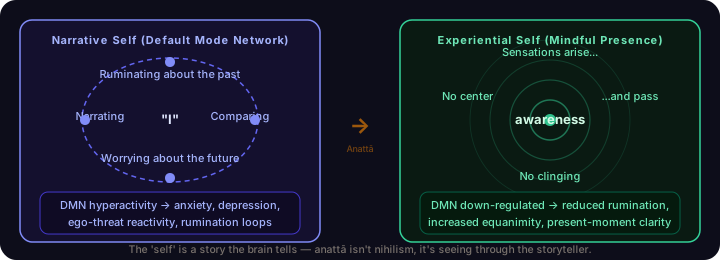
Neuroscientist and meditation teacher Sam Harris extends this: the sense of being a subject located 'behind the eyes' — what philosophers call the felt sense of a Cartesian theater — is not a perception of a real object. It is a cognitive construction, and like all constructions, it can be seen through. The Default Mode Network (DMN), a set of brain regions most active during mind-wandering, self-referential thought, and rumination, is the neural substrate of this narrative self. Research consistently shows that experienced meditators exhibit marked down-regulation of DMN activity during practice, and that this down-regulation correlates with subjective reports of reduced ego-attachment, reduced rumination, and increased equanimity.
The practical implication of anattā is significant and underappreciated. A large category of psychological suffering is ego-related — it is suffering that arises because events feel threatening to the narrative self: the shame of failure (threat to self-image), the anxiety of uncertainty (threat to the story's future), the anger of disrespect (threat to status within the story). None of these are responses to bare events. They are responses to what the events mean for the narrative. Training the mind to see that the narrative is a construction — useful but not ultimate — creates the possibility of experiencing the events without the secondary suffering layer that the narrative generates.
02 Visual Overview
03 Case Study
CASEMichael S. Gazzaniga, Ph.D., *The Social Brain* (1985); *Who's in Charge? Free Will and the Science of the Brain* (2011)
Gazzaniga's collaborations with neurosurgeon Joseph Bogen and neurologist Roger Sperry in the 1960s studied patients who had undergone corpus callosotomy — surgical severing of the main connection between the brain's two hemispheres — to control severe epilepsy. In one canonical experiment, the word 'WALK' was flashed to the right hemisphere (which controls the left side of the body). The patient stood up and began walking. When Gazzaniga asked why, the patient — whose left hemisphere had seen nothing — immediately produced an answer: 'I wanted to get a Coke.' The left hemisphere had no access to the real cause of the action. It simply generated a plausible story in real time and delivered it with full confidence. Gazzaniga documented this pattern across hundreds of trials and dozens of patients. He eventually formalized the observation: the interpreter module 'is driven to hypothesize about the relationship between all the stuff it is receiving' and 'never says "I don't know."' It is, in his phrase, an inference machine that keeps the narrative coherent at the expense of accuracy.
→ Why it matters
The implications for the Buddhist concept of anattā are direct: the self that feels like an executive making conscious decisions is, to a significant degree, a post-hoc narrator generating explanations for actions that were already initiated by processes it had no access to. Anattā practice is, from this angle, simply learning to see what the neuroscience of split-brain patients reveals structurally: the narrator is real, but it is not the pilot.
CASEJudson Brewer, Kathleen Worhunsky, et al., *Meditation experience is associated with differences in default mode network activity and connectivity* (PNAS, 2011)
Brewer's neuroimaging study compared the DMN activity of experienced meditators (mean 10,000+ hours of practice) with novice meditators across three different meditation types: focused attention, loving-kindness, and choiceless awareness. In every condition, experienced meditators showed significantly reduced activity in key DMN regions — the medial prefrontal cortex and the posterior cingulate cortex — that are associated with self-referential processing and mind-wandering. More striking than the overall reduction was a finding about the posterior cingulate specifically: it is the region most associated with the feeling of 'stickiness' — the subjective sense that a thought or emotion has grabbed you, that you are in it rather than observing it. Experienced meditators showed reduced connectivity to exactly this region. Their brains were less likely to get caught in the self-referential loop that converts a momentary thought into an extended narrative episode.
→ Why it matters
Brewer's study provides a neural correlate for what anattā practice phenomenologically describes: training the mind to see through the narrative self is not a conceptual exercise but a measurable change in how the brain's self-referential circuitry activates. Less DMN 'stickiness' means thoughts arise and pass without capturing the system — which is precisely what Buddhist texts mean by 'not-self' as a mode of perception rather than a metaphysical belief.
04 Key Points
01Anattā is not nihilism — it does not deny functional existence; it denies the existence of a fixed, permanent executive self
02The Buddha's five aggregates (khandhas) decompose 'self' into five interacting processes, none of which is the self itself
03Gazzaniga's split-brain experiments confirmed that the self is a post-hoc narrative generated by a left-hemisphere interpreter, not a decision-maker
04The Default Mode Network is the brain's neural substrate of self-referential narrative — experienced meditators show measurable down-regulation of DMN activity
05Ego-related suffering (shame, status anxiety, identity threat) is generated by what events mean for the narrative, not by the bare events — anattā practice targets this layer specifically