Impermanence (Anicca) and Psychological Flexibility
BeginnerThe mind that clings to a fixed world in a changing one is perpetually generating its own suffering
01 The Concept
Impermanence — anicca in Pali — is one of the three characteristics of existence that Buddhist analysis identifies as universal. Everything that arises is conditioned by prior causes, and because those causes shift, what they produce shifts with them. This is not pessimism about change; it is a precise observational claim about the structure of conditioned experience. The flower is impermanent. The feeling of anger is impermanent. The sense of 'myself' is impermanent. Even the perception of impermanence is impermanent.
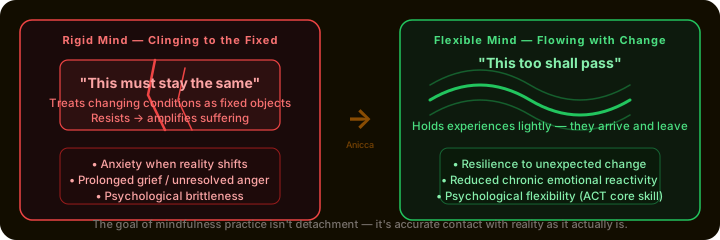
The suffering that anicca generates — and it is one of the central sources of dukkha — arises not from impermanence itself but from the mind's response to it. The human brain, shaped by evolutionary pressures that prioritized predictability and pattern-stability, treats dynamic, shifting processes as though they were static objects. It builds a model of the world, of people, of the self, and then responds with threat-activation when reality departs from the model. Grief is the pain of the model colliding with absence. Anxiety is the pain of the model colliding with uncertainty. Much of what presents clinically as psychological suffering is this: a gap between what the mind insists should be stable and what is actually in motion.
In contemporary psychotherapy, this insight has been operationalized most precisely in Acceptance and Commitment Therapy (ACT), developed by Steven Hayes at the University of Nevada in the 1980s and 1990s. ACT's central construct is psychological flexibility — the capacity to contact experience as it actually is, including painful experience, without either avoidant struggle or rigid control strategies. Hayes identified that a large portion of psychological suffering is not generated by the initial aversive experience but by the secondary struggle against that experience — the meta-layer of 'I shouldn't feel this' or 'this must stop' that amplifies the original signal.
Anicca practice doesn't ask you to be indifferent to loss. It doesn't ask you to enjoy impermanence. It asks you to see it accurately — to notice that the feeling arising now is arising, that it has qualities, and that those qualities are changing, even as you observe them. The clinical research literature on ACT demonstrates that this shift in relationship to experience — from control and avoidance to accurate contact and flexible response — produces measurable and durable reductions in depression, anxiety, chronic pain, and addiction, and does so more robustly than treatment modalities focused on changing the content of thoughts rather than the relationship to those thoughts.
02 Visual Overview
03 Case Study
CASEJudson Brewer, M.D., Ph.D., *Unwinding Anxiety* (2021); Brewer et al., *Craving to Quit* (2013 clinical trial, Mindfulness-Based Substance Use Treatment)
Brewer, a psychiatrist and neuroscientist at Brown University, spent a decade studying what he calls 'habit loops' — the trigger–behavior–reward cycles that sustain anxiety, addiction, and rumination. His central finding was that the brain's compulsive response to uncertainty is itself a habit loop, shaped by the same operant conditioning that shapes any other behavior: the behavior (worry, control attempts, substance use) is reinforced by short-term relief from discomfort, even when it makes the long-term situation worse. In one series of smoking cessation trials, Brewer's team found that standard behavioral interventions had a 5-times-worse quit rate compared to a mindfulness protocol that taught participants to simply observe the craving as a physical sensation arising in the body — noticing its qualities, its location, its intensity — without immediately acting on it. The craving itself, observed accurately, peaks and passes. The loop that converts craving into compulsion requires the avoidant struggle; remove the struggle, and the loop loses its self-reinforcing power.
→ Why it matters
Brewer's neuroscience research provides a mechanistic account of exactly what Buddhist teachers mean by 'riding the wave' of anicca: cravings, urges, and anxiety sensations are impermanent events in the nervous system. When the mind stops struggling against their impermanence and contacts them with accurate curiosity, the loop that makes them self-perpetuating is interrupted — not by force, but by clear seeing.
CASESteven C. Hayes, Ph.D., *Get Out of Your Mind and Into Your Life* (2005); Levin et al., *ACT Meta-Analysis* (Behavior Therapy, 2012)
Hayes developed the theoretical foundations of ACT after his own experience with panic disorder in the early 1980s. His insight came from trying — and failing — to control his panic responses through willpower and suppression. The harder he pushed the thoughts away, the more potent they became. He eventually recognized that the strategy itself was the problem: experiential avoidance (attempting to suppress or escape from aversive internal experience) was not a solution to anxiety but its amplifier. The meta-analysis of ACT trials published in 2012 found consistent medium-to-large effect sizes across depression, anxiety, chronic pain, and substance abuse — and found that the mechanism of change was specifically reduced experiential avoidance, not changes in thought content. People weren't getting better because their thoughts became less negative; they were getting better because they stopped treating negative thoughts as threats to be eliminated.
→ Why it matters
Hayes's personal and clinical discovery maps directly onto the Buddhist insight about impermanence: the mind that fights its own impermanent content treats it as permanent and threatening. The mind that observes that content as arising, having qualities, and passing — that mind can move through difficult experience without being captured by it.
04 Key Points
01Anicca is not a claim that change is bad — it is a structural observation that everything conditioned by causes shifts as those causes shift
02Suffering from impermanence arises from the gap between the brain's preference for stable models and reality's actual fluidity
03Acceptance and Commitment Therapy's concept of psychological flexibility is the operationalized clinical equivalent of anicca practice
04The secondary struggle against aversive experience — 'I shouldn't feel this' — is often more damaging than the primary experience itself
05Mindful contact with impermanence doesn't eliminate pain; it interrupts the amplification loop that converts pain into chronic suffering