The Four Noble Truths as Cognitive Diagnostics
BeginnerThe Buddha's diagnostic framework and Aaron Beck's CBT are independent discoveries of the same architecture
01 The Concept
In 1960s Philadelphia, psychiatrist Aaron Beck noticed that his depressed patients shared a pattern: their suffering wasn't random. It followed a predictable architecture — a triggering situation, an automatic interpretation of that situation, a cascade of negative emotion, and ultimately a behavioral withdrawal that reinforced the whole cycle. Beck called this the cognitive model, built a clinical framework around it, and eventually received the Lasker Award — medicine's equivalent of a Nobel — for the insight.
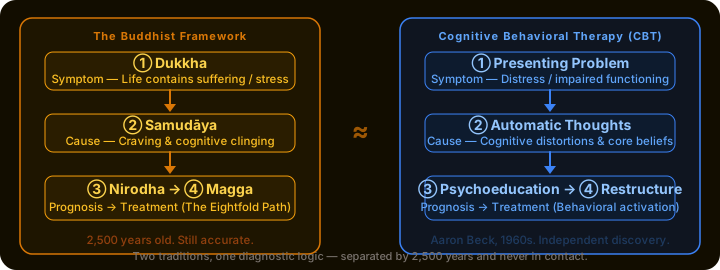
Twenty-five centuries earlier in a forest in northern India, a mendicant teacher named Siddhattha Gotama described what he called the Four Noble Truths. First, that suffering (dukkha) is an irreducible feature of conditioned existence — not a cosmic mistake, but a diagnostic fact. Second, that suffering has an identifiable cause (samudāya): craving and its companion, cognitive clinging — the mind's compulsive habit of grasping at pleasant experiences and recoiling from unpleasant ones. Third, that cessation (nirodha) is possible — the pattern is not locked in. Fourth, that there is a practical path (magga) for bringing it about.
The structural isomorphism is striking. Both frameworks move from symptom to etiology to prognosis to treatment. Both locate the causal mechanism not in external events but in the mind's relationship to those events — specifically, in the automatic interpretive and craving responses that transform neutral experience into distress. Beck calls this cognitive distortion; the Pali tradition calls it papañca — mental proliferation, the mind spinning out an event into a story that generates its own suffering independently of the original trigger.
The practical import is not that Buddhism and CBT are identical — they diverge sharply at the level of ontology, the nature of self, and the ultimate goal of practice. But the diagnostic architecture is common ground. Both claim that the thing generating suffering is not the raw content of experience but the mind's mode of processing that content. This means the suffering is, in principle, workable. The mind that generates it is the same mind that can be trained to stop.
02 Visual Overview
03 Case Study
CASEJeffrey Schwartz, M.D., *Brain Lock: Free Yourself from Obsessive-Compulsive Behavior* (1996); Schwartz & Begley, *The Mind and the Brain* (2002)
In the late 1980s, Schwartz was treating patients with obsessive-compulsive disorder at UCLA when he recognized that standard pharmacological approaches were suppressing symptoms without addressing the mechanism. He began training OCD patients in a four-step mindfulness-based relabeling process that drew explicitly on Buddhist practice: Relabel (this is OCD, not a real threat), Reattribute (this is a misfiring brain circuit, not a meaningful signal), Refocus (redirect attention to a constructive behavior for 15 minutes), Revalue (the intrusive thought is not 'me' — it is noise). Using PET brain imaging before and after the intervention, Schwartz documented measurable changes in caudate nucleus activity — the same brain region hyperactive in OCD — produced by this attention-training protocol alone, without medication. His patients were not changing their brain chemistry through drugs; they were changing it through directed attention.
→ Why it matters
Schwartz's work demonstrated that the Buddhist insight about the workability of the mind through trained attention is not metaphysical — it is mechanistically supported. The Four Noble Truths' claim that suffering has a cause that can be modified maps onto a verifiable neurobiological reality: the mind's trained response to its own processes changes the brain structures that generate those processes.
CASEAaron T. Beck, M.D., *Cognitive Therapy and the Emotional Disorders* (1976); Dobson, *Handbook of Cognitive-Behavioral Therapies* (4th ed., 2019)
Beck's original discovery came from a session he considered routine. A patient he was treating psychoanalytically reported feeling anxious and guilty during the session itself. When Beck probed what the patient had been thinking simultaneously with the overt verbal content — the stream of self-evaluative commentary running beneath the conversation — the patient described a rapid, automatic sequence of thoughts he hadn't even recognized as thoughts: 'I'm boring him. I'm wasting his time. He probably thinks I'm stupid.' None of these thoughts had been verbally expressed. They ran in parallel to the conscious session, generating anxiety independently. Beck realized that treatment had been targeting the patient's emotions and verbal content while entirely missing the actual engine of distress: the automatic interpretive layer that was generating both.
→ Why it matters
Beck's discovery of the automatic thought — the rapid, habitual interpretive layer beneath conscious experience — is structurally identical to what the Buddhist tradition calls *saṅkhāra* (volitional formations) and *papañca* (mental proliferation). Both traditions identified the same hidden machinery. Neither culture had contact with the other at the time of discovery.
04 Key Points
01Both the Four Noble Truths and CBT use the same four-stage clinical architecture: symptom → cause → prognosis → treatment
02The causal mechanism in both frameworks is not the external event but the mind's automatic interpretive response to it
03Dukkha (suffering) and cognitive distortion both describe the same phenomenon: a mismatch between reality and the mind's constructed overlay of it
04The Buddha's term papañca (mental proliferation) maps precisely onto the CBT concept of automatic thoughts generating secondary distress
05Neither framework requires that suffering be eliminated — both require only that the relationship to experience be changed